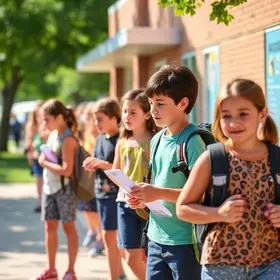
Sandy Ridge School in Nappanee, IN offers co–ed education for grades 1 through 8 in a rural community setting with Amish religious affiliation.
The school enrolls 69 students with a student–teacher ratio of 23:1 supported by 3 teachers.
As a rural Indiana private school, Sandy Ridge serves elementary and middle school grade levels within a religiously affiliated program.
Nearby K–8 private schools in Nappanee have lower student–teacher ratios, ranging from 10:1 to 19:1, for comparison.
Quick Facts (2026)
- Grades: 1-8
- Enrollment: 69 students
- Application Deadline: None / Rolling
- Source: National Center for Education Statistics (NCES)
School Overview
Religious Affiliation
Grades Offered
Grades 1-8
Student Body
Total Students
69 students
Student Body Type
Co-ed
Students by Grade
Academics and Faculty
Total Classroom Teachers
3 teachers
Student-Teacher Ratio
23:1
National avg.:
Tuition and Acceptance Rate
Admission Deadline
None / Rolling
Source: National Center for Education Statistics (NCES)
Frequently Asked Questions
When is the application deadline for Sandy Ridge School?
The application deadline for Sandy Ridge School is rolling (applications are reviewed as they are received year-round).
School Reviews
Endorse Sandy Ridge School. Endorsements should be a few sentences in length. Please include any comments on:
- Quality of academic programs, teachers, and facilities
- Availability of music, art, sports and other extracurricular activities
- Academic or athletic awards
Recent Articles

How 91ºÚÁÏs Are Preventing Student Burnout
Discover how private schools are addressing student burnout through wellness programs, balanced academics, and expanded mental health support.

How 91ºÚÁÏs Evaluate “Soft Skillsâ€� Like Leadership and Grit
Learn how private schools assess leadership, grit, resilience, and character, and why these soft skills are becoming increasingly important in admissions.
How 91ºÚÁÏs Handle Cell Phones: Why Phone-Free Campuses Are Growing
Discover how private schools manage cell phones, why phone-free campuses are growing, and how reduced social media access can benefit students.