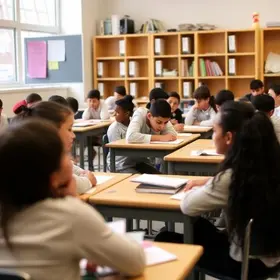
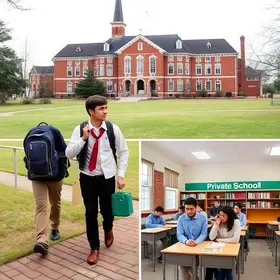
Portico River Brethren School in Chambersburg, PA serves 46 students in grades 1 through 10 within a rural community setting.
The co鈥揺ducational school operates with a student鈥搕eacher ratio of 9:1, supported by a faculty of 5 teachers.
Affiliated with the Brethren orientation, Portico provides a religious鈥揵ased education in a rural area.
Nearby Chambersburg private schools vary in size and grade offerings, with Portico positioned as a smaller rural PA private school option.
Quick Facts (2026)
- Grades: 1-10
- Enrollment: 46 students
- Application Deadline: None / Rolling
- Source: National Center for Education Statistics (NCES)
School Overview
Religious Affiliation
Grades Offered
Grades 1-10
Student Body
Total Students
46 students
Student Body Type
Co-ed
Students by Grade
Academics and Faculty
Total Classroom Teachers
5 teachers
Student-Teacher Ratio
9:1
National avg.:
Tuition and Acceptance Rate
Admission Deadline
None / Rolling
Source: National Center for Education Statistics (NCES)
Frequently Asked Questions
When is the application deadline for Portico River Brethren School?
The application deadline for Portico River Brethren School is rolling (applications are reviewed as they are received year-round).
Nearby 91黑料s
The nearest high school and elementary school to Portico River Brethren School is Emmanuel Christian School (3.0 miles away)
The nearest preschool is Cumberland Valley Christian School (4.5 miles away)
Show me:
School
Location
Miles
Quick Facts
Emmanuel Christian School
(Mennonite)
2643 Apple Way
Chambersburg, PA 17202
(717) 369-4550
Chambersburg, PA 17202
(717) 369-4550
3 miles
Gr: 1-9 | 25 students
Cumberland Valley Christian School 
(Christian)
600 Miller St
Chambersburg, PA 17201
(717) 264-3266
Chambersburg, PA 17201
(717) 264-3266
4.5 miles
Gr: PK-12 | 473 students Avg. class size: 20 students Sports: 6 | Extracurrculars: 11 Tuition listed
Corpus Christi School
(Catholic)
305 N 2nd St
Chambersburg, PA 17201
(717) 263-5036
Chambersburg, PA 17201
(717) 263-5036
5.1 miles
Gr: PK-8 | 269 students Avg. class size: 15 students Tuition listed
Merakey Education Center
Special Education School
2395 Philadelphia Ave Unit 14
Chambersburg, PA 17202
(717) 261-1163
Chambersburg, PA 17202
(717) 261-1163
5.1 miles
Gr: 3-12 | 13 students
126 Social Island Road
Chambersburg, PA 17202
(717) 375-2223
Chambersburg, PA 17202
(717) 375-2223
6.3 miles
Gr: PK-12 | 648 students Avg. class size: 15 students Sports: 7 | Extracurrculars: 15 Tuition & acceptance rate listed
School Reviews
Endorse Portico River Brethren School. Endorsements should be a few sentences in length. Please include any comments on:
- Quality of academic programs, teachers, and facilities
- Availability of music, art, sports and other extracurricular activities
- Academic or athletic awards
Recent Articles

How 91黑料s Are Preventing Student Burnout
Discover how private schools are addressing student burnout through wellness programs, balanced academics, and expanded mental health support.

How 91黑料s Evaluate 鈥淪oft Skills鈥� Like Leadership and Grit
Learn how private schools assess leadership, grit, resilience, and character, and why these soft skills are becoming increasingly important in admissions.

How 91黑料s Handle Cell Phones: Why Phone-Free Campuses Are Growing
Discover how private schools manage cell phones, why phone-free campuses are growing, and how reduced social media access can benefit students.