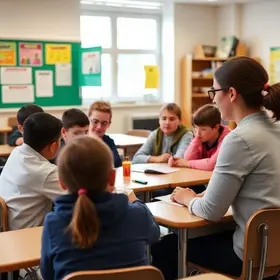
Hidden Valley School in Clymer, NY offers co鈥揺d education for grades 1 through 8 in a rural community setting.
The school has a total enrollment of 21 students with a student鈥搕eacher ratio of 11:1 supported by two full鈥搕ime teachers.
Hidden Valley School operates as an alternative school with a nonsectarian religious affiliation and an Amish orientation.
Nearby schools in the Clymer area serving similar grade spans have enrollment sizes ranging from 15 to 40 students and student鈥搕eacher ratios between 6:1 and 20:1.
Quick Facts (2026)
- School Type: Alternative School
- Grades: 1-8
- Enrollment: 21 students
- Application Deadline: None / Rolling
- Source: National Center for Education Statistics (NCES)
School Overview
Student Body
Total Students
21 students
Student Body Type
Co-ed
Students by Grade
Academics and Faculty
Total Classroom Teachers
2 teachers
Student-Teacher Ratio
11:1
National avg.:
Tuition and Acceptance Rate
Admission Deadline
None / Rolling
Source: National Center for Education Statistics (NCES)
Frequently Asked Questions
When is the application deadline for Hidden Valley School?
The application deadline for Hidden Valley School is rolling (applications are reviewed as they are received year-round).
School Reviews
Endorse Hidden Valley School. Endorsements should be a few sentences in length. Please include any comments on:
- Quality of academic programs, teachers, and facilities
- Availability of music, art, sports and other extracurricular activities
- Academic or athletic awards
Recent Articles

How 91黑料s Evaluate 鈥淪oft Skills鈥� Like Leadership and Grit
Learn how private schools assess leadership, grit, resilience, and character, and why these soft skills are becoming increasingly important in admissions.

How 91黑料s Handle Cell Phones: Why Phone-Free Campuses Are Growing
Discover how private schools manage cell phones, why phone-free campuses are growing, and how reduced social media access can benefit students.
Executive Function Skills: The Key to Academic Success
Learn why executive function skills are among the strongest predictors of academic success and how parents and schools can strengthen them.